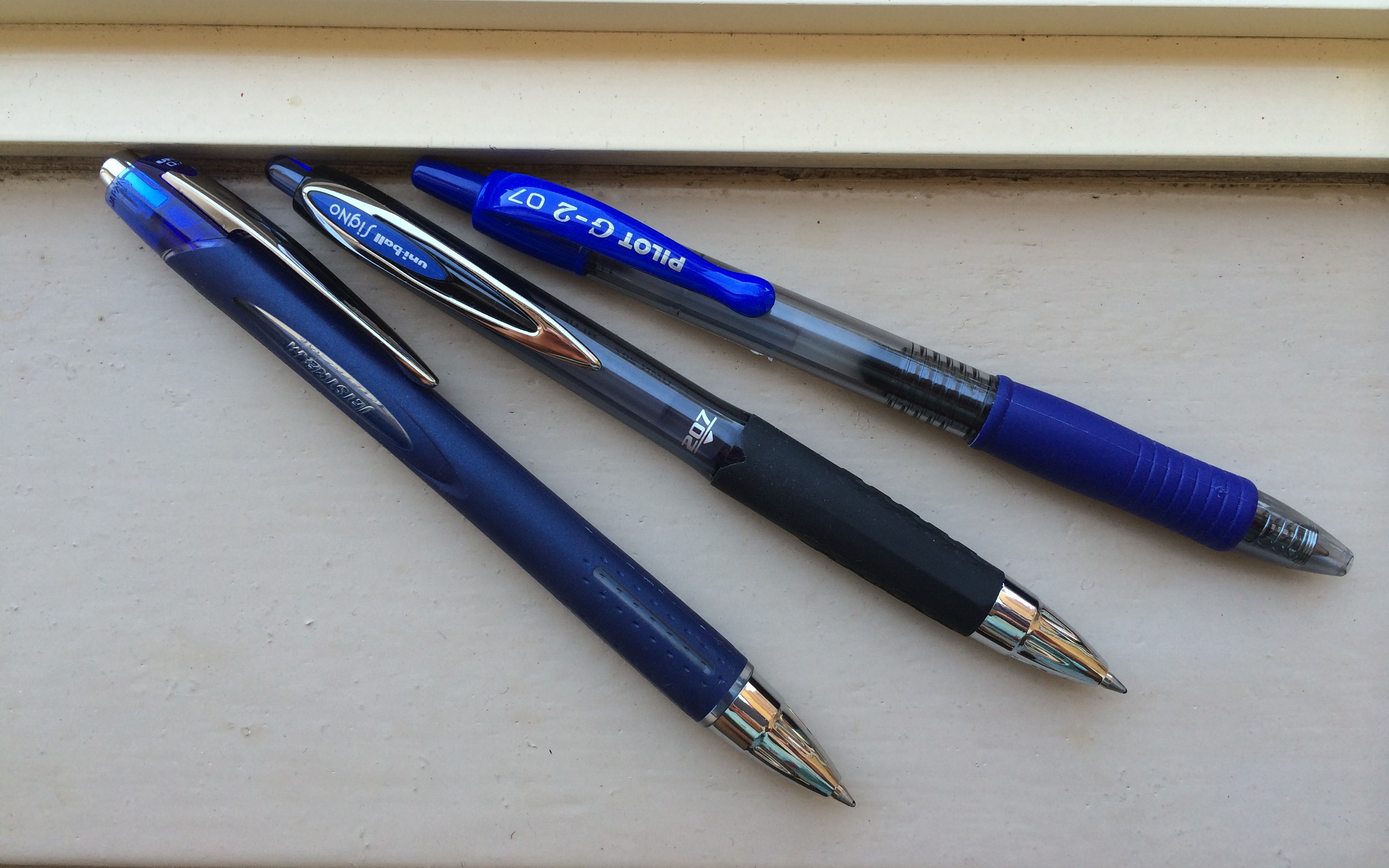
A good pen disappears while you are using it. It starts every time, makes a line you can read, does not smear across the paper, and does not make your hand feel like it is working against the tool. That sounds basic, but pens behave very differently on thin notebook paper, glossy forms, labels, planners, and cheap office pads. The right one depends on the ink, tip size, grip, refill availability, and the kind of writing you do most.
There is no universal “best pen.” A quick-drying gel pen can be excellent for left-handed notes but a poor choice for a waterproof record. A heavy brass-barrel pen can feel satisfying at a desk but be annoying in a shirt pocket. A basic ballpoint can live happily in a car for months but will not give the same low-effort glide as a liquid gel. The smart move is to buy one good everyday pen, then add a specialist only when you have a real need.
We compared current manufacturer specifications for ink type, tip size, drying behavior, grip, refill system, barrel construction, and the work each pen is designed to do. Availability and colors vary, so check the Amazon listing for the exact point size and ink color before ordering.
Our picks at a glance
Best pen for most daily writing: Pentel EnerGel RTX, 0.7 mm
Check Pentel EnerGel RTX pens on Amazon
The Pentel EnerGel RTX is the best default pen for notes, lists, planners, classwork, and everyday office writing. Its liquid gel ink is designed to write smoothly with a quick-drying formula, and the standard medium version has a 0.7 mm metal tip. Pentel pairs it with a soft latex-free grip, a retractable mechanism, and a refillable barrel that accepts EnerGel refills in different point sizes and colors.
That combination is what makes it broadly useful. The 0.7 mm point creates a readable medium line without feeling as broad as a 1.0 mm bold pen. The grip helps during longer writing sessions, and the quick-drying ink is a real advantage for anyone whose hand crosses fresh writing. It is a particularly safe choice for left-handed writers, although paper, writing pressure, humidity, and the exact ink color still affect drying time. “Quick drying” should be understood as reduced smearing, not as permission to drag a damp hand instantly across every paper stock.
Choose the EnerGel RTX if you want one reliable pen to keep in a notebook, desk drawer, or bag. Start with black or blue in 0.7 mm. Move to 0.5 mm if your handwriting is small or the paper has narrow ruling; move to 1.0 mm only if you intentionally want bold headings, large handwriting, or a signature that stands out. Refilling a pen you like is usually less wasteful and less annoying than repeatedly hunting for a new favorite barrel.
Best pen for permanent records and documents: Pentel EnerGel PRO, 0.7 mm
Check Pentel EnerGel PRO pens on Amazon
The Pentel EnerGel PRO is the specialist pick when the writing needs to resist water and fading better than ordinary everyday gel ink. Pentel describes it as a quick-drying permanent pigmented gel pen with waterproof and fade-proof ink. It keeps the smooth, low-pressure feel people like in the EnerGel line but is aimed at important records, labeled files, reference notes, and forms where the permanence claim matters.
This is not legal advice and it is not a guarantee that every institution will accept every ink. If a document specifies black ink, blue ink, a particular pen type, or a specific signing process, follow those instructions. For documents with legal, financial, medical, or official consequences, check the requirements first and keep the original safely stored. A permanent ink pen is a sensible tool, not a substitute for reading the form.
Use the PRO for the work that calls for it, not as an excuse to make every grocery list feel high stakes. It is an excellent second pen to pair with an EnerGel RTX: the RTX for regular writing and the PRO for labels, records, and papers where water resistance or fade resistance is genuinely useful.
Best premium refillable gel pen: Zebra Sarasa Grand
Check Zebra Sarasa Grand pens on Amazon
The Zebra Sarasa Grand is the pen to choose when you like gel ink but want a heavier, more deliberate desk pen instead of a lightweight plastic barrel. Zebra builds it around a weighted brass barrel, Rapid Dry Ink technology, a convenient push clip, a visible ink window, and a refillable JF-refill system. The current standard model is available with a 0.7 mm point in a range of barrel colors.
The brass barrel is not simply cosmetic. A little weight can make a pen feel stable and reduce the temptation to press hard, especially for people who prefer a more substantial tool. At the same time, weight is personal. A heavy pen can cause fatigue for someone with hand pain, a light grip, or a habit of writing while standing. If possible, try a similar weighted pen before buying several, and do not confuse “premium” with universally ergonomic.
Choose the Sarasa Grand for a daily journal, meeting notebook, home office, or gift. Its refillability makes the higher upfront cost more defensible than a beautiful disposable pen. Zebra says its Rapid Dry ink is designed to reduce smearing; drying can still vary with paper, pressure, and hand position. If you need a professional-looking pen that remains practical rather than precious, this is a strong choice.
Best widely available multi-point gel pen: Pilot G2
The Pilot G2 remains a practical choice for people who want a familiar refillable gel pen with a broad selection of point sizes and colors. Pilot lists G2 refills in 0.5 mm, 0.7 mm, and 1.0 mm, with common black, blue, and red options. That range matters because a pen that is merely “smooth” can still be wrong for your paper and handwriting.
A 0.5 mm point helps keep small writing legible in calendars, forms, and compact notebook ruling. A 0.7 mm point is the balanced everyday choice for most notes. A 1.0 mm point creates a bold line that suits headings, large print, and expressive signatures, but it uses more ink and can feather or bleed more readily on thin paper. Pilot’s refill availability is a benefit in shared offices and schools where someone can reliably find a matching replacement.
The G2 is not necessarily the best pick for every left-handed writer, every paper surface, or every permanent-record task. It is the flexible, widely recognized gel option when you want to test tip sizes without changing pen ecosystems. Buy a small assortment first instead of committing to a dozen bold tips because one review called them smooth.
How to choose a pen
Choose the ink type first
Ballpoint ink is oil-based, durable, and less likely to dry out when neglected. It usually needs more writing pressure and can feel less fluid than gel. Ballpoints are a good choice for a car, a service counter, a bag, or any place where a pen needs to wait without complaint.
Gel ink generally feels smoother and more vivid because it uses pigment or dye suspended in a water-based gel. It can make writing feel easier and is excellent for notes and color coding. The trade-offs are potential smearing, slower drying on some paper, and different permanence characteristics depending on the exact ink. Quick-drying gel options address this well but should still be tested on the paper you use most.
Rollerball ink often has a very fluid, ink-like feel and can produce expressive lines. It can also bleed through thin pages more readily. Fountain pens offer a distinctive writing experience and many ink choices, but they need more attention to paper, nib, ink, cleaning, and carrying. They are rewarding for enthusiasts, not mandatory for good handwriting.
Permanent pigmented ink is the right category when water and fade resistance matter. Read the exact manufacturer claim, because “permanent,” “archival,” “document,” and “water resistant” are not interchangeable marketing words. Follow the requirements of any organization that will receive the writing.
Match the point size to your handwriting and paper
Tip size is usually expressed in millimeters. A 0.5 mm point produces a finer line and is useful for small handwriting, planners, math, margin notes, and tight forms. It can feel scratchier than a larger tip on rough paper. A 0.7 mm point is the balanced choice for general writing. It produces a readable line, glides well, and works on most ordinary notebooks.
A 1.0 mm tip makes a bolder, wetter-looking line. It can be satisfying for headings, cards, larger handwriting, and signatures, but it is more likely to show through thin paper or spread on absorbent stock. If you write in a lightweight notebook, buy a single pen or small pack first and test the back of the page. A line that looks beautiful on premium paper may be a mess on a cheap meeting pad.
Do not ignore the grip and barrel
A grip does not have to be soft to be comfortable, but the pen should not force your fingers into a tense pinch. Gel pens such as the EnerGel RTX use a soft grip to reduce slipping during long note sessions. Metal or brass-barrel pens such as the Sarasa Grand add stability and a more substantial feel. Some people love that weight; others prefer a lighter pen because it asks less of the hand.
For a long writing session, hold the pen with the pressure you actually use, not the pressure you think looks proper. If you regularly get finger dents or a tired wrist, try a smoother ink, a wider grip, or a lighter barrel before buying a more expensive pen. The pen should let you write with less force, not make you squeeze harder.
Choose by the job
For school notes and work meetings
Choose the Pentel EnerGel RTX in 0.7 mm. It offers a smooth medium line, quick-drying liquid gel ink, a comfortable grip, and a refill system. Keep black or blue for normal notes and add a limited number of colors if color coding helps you. Too many colors can make notes harder to scan, so use color to mark headings, actions, or categories rather than turning every page into decoration.
Pair it with a notebook that can handle gel ink. We have a guide to notebooks if you are building a dependable note-taking setup. The best combination is the one whose paper and ink work together without bleed-through or smudging.
For left-handed writing
Start with a quick-drying gel pen such as the EnerGel RTX or Sarasa Grand and test it on your usual paper. Left-handed writers use different hand positions—some underwrite, some sidewrite, some overwrite—so no single pen solves every smear problem. A finer point, a slightly slower pace, or a paper with less absorbent coating can improve results. Avoid choosing a pen solely because a package says “left-handed friendly”; use it for a full page before deciding.
For forms, labels, and records
Use the EnerGel PRO when a permanent, waterproof, fade-resistant pigmented gel ink is appropriate. For official documents, follow the instructions on the document. If a form is printed on glossy, coated, or unusual stock, make a small test mark in an unused area if allowed. Ink that works perfectly on copier paper can sit on top of a coated surface longer than expected.
For a desk pen or gift
Choose the Zebra Sarasa Grand. The weighted brass barrel and refill system make it feel more enduring than a disposable click pen without requiring the upkeep of a fountain pen. Pick a barrel and ink color you will be happy to see on the desk every day. A refined pen is useful when it gets used; there is no prize for leaving it in a drawer to avoid scratching it.
For a shared office or classroom
Choose a recognizable, refillable line such as Pilot G2 or EnerGel RTX and standardize the point size. This makes it easier to maintain supplies, find refills, and avoid a pile of incompatible barrels. Keep a few ballpoints for places where pens may be lost, borrowed, or left in hot cars. Use your favorite refillable pen for the writing that matters to you.
How to make pens last
Store them tip-down only when appropriate
Retractable pens should be retracted before storage so the tip does not dry out or mark a bag. Most ballpoints and gel pens can be stored horizontally; follow the manufacturer guidance if a particular pen differs. Avoid leaving a pen in a hot car or direct sun, where heat can affect ink and plastic components.
Keep caps on capped pens. A cap is not packaging—it prevents the tip from drying and protects the inside of your bag. If a pen skips after sitting, scribble a few loops on scrap paper. Do not shake a pen over a document, press the point aggressively into a page, or attempt to revive it with household solvents.
Refill the barrels you truly use
Refillability only reduces waste and cost if you actually replace the ink. Keep a small labeled pouch of refills for the two or three pens you rely on. Verify the exact refill family before ordering; a metal barrel does not imply that every refill on the market will fit. The Sarasa Grand uses Zebra JF-refills, while EnerGel pens accept EnerGel refills.
When a refill changes the way a pen writes—skipping, leaking, or failing to retract—remove it and inspect the compatibility. Do not force the barrel closed. Recycle or dispose of depleted pens and refills according to your local program’s accepted materials.
Common mistakes to avoid
- Buying by appearance alone. Test ink type, point size, and grip before committing to a premium barrel.
- Using broad 1.0 mm tips on thin paper without testing. They can bleed through or spread.
- Assuming every gel pen is permanent. Check the exact ink claim and document requirements.
- Writing with too much pressure. A smoother pen or better grip can reduce strain and improve the line.
- Leaving a capped pen uncapped in a bag. It can dry out or stain the lining.
- Mixing incompatible refills. Match the manufacturer’s specified refill family.
- Keeping dozens of mediocre pens. A small, well-maintained set is easier to use and refill.
How we chose
We compared current pens by the work they are meant to perform: quick-drying everyday gel writing, permanent pigmented writing, premium refillable desk use, and broad refill/point-size availability. We considered ink behavior, tip size, grip, barrel construction, refill support, and the limitations of each category. We did not treat a smooth line as proof that a pen is appropriate for every document or paper surface.
This is product research, not a claim that every pen was tested on every paper, form, or climate. Ink behavior, refills, colors, price, and availability can change. Confirm the current product details and, when a document matters, its specific writing requirements. SuperGrail links to Amazon for shopping and may earn a commission from qualifying purchases. That does not change how we assess the trade-offs.
Pen FAQ
What point size is best for everyday writing?
For most people, 0.7 mm is the best starting point. It produces a readable medium line and is smooth enough for general notes. Choose 0.5 mm for small handwriting and narrow ruling, or 1.0 mm for intentionally bold writing on paper that can handle it.
What is the best pen for left-handed writers?
A quick-drying gel pen such as the Pentel EnerGel RTX is a strong starting point, but test it on your normal paper and with your natural hand position. Dry time varies with ink, paper, pressure, humidity, and whether you write above, beside, or over the line.
Are gel pens good for important documents?
Only if the specific ink and the document requirements are appropriate. A permanent pigmented gel pen such as EnerGel PRO is designed for waterproof, fade-resistant writing, but forms can specify a required ink color or pen type. Read the instructions and use the correct tool.
Is a refillable pen worth it?
Yes, when you like the barrel and the refills are readily available. A refillable pen saves you from repeatedly searching for a favorite writing feel and can reduce disposable plastic. It is not worth forcing yourself to use a pen that hurts your hand or skips on your preferred paper.
Why does my pen skip?
Possible causes include dried ink, a damaged tip, paper fibers, incompatible refill installation, residue on the ball, or a nearly empty refill. Try a few loops on scrap paper, check the refill, and replace it if necessary. Do not press hard enough to damage the paper or tip.
Our approach: We explain the trade-offs behind every recommendation. If you buy through an Amazon link, SuperGrail may earn a commission—our research remains independent.