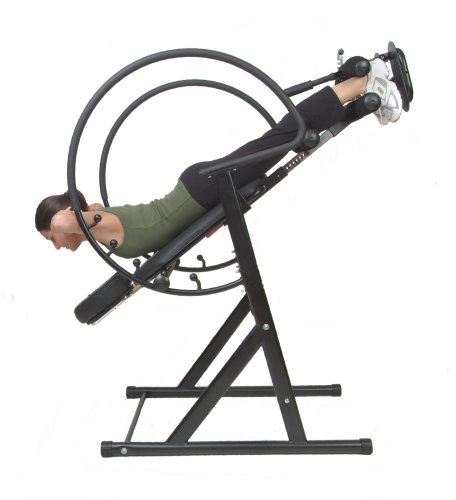
An inversion table turns a simple idea into a large piece of equipment: secure your ankles, lean back, and use your body weight to create a traction-like feeling through the back. Some people report short-term relief or enjoy the stretch. That is not the same as a diagnosis, a cure, or proof that inversion is right for your body. The evidence for long-term benefit is limited, while the consequences of using the wrong device—or using the right device despite a medical contraindication—can be serious.
Our first recommendation is deliberately cautious: do not buy an inversion table until a qualified clinician says inversion is appropriate for your symptoms and health history. If you do have that clearance, choose a stable model with a clear manual, secure ankle retention, understandable setup, and a return process that lets you test fit and operation carefully. Start with a modest angle, a short session, and another adult nearby while you learn the device.
Our picks at a glance
- Best premium system to consider after medical clearance: Teeter FitSpine LX9 is the type of premium table to compare when you want clear support materials and a refined fit system.
- Best mainstream option: Teeter FitSpine X3 is a sensible model to investigate if its user range and instructions fit you.
- Best budget direction: Innova ITX9600 is a lower-cost category choice only when its limits, assembly, ankle lock, and return terms check out.
- Best first purchase for uncertain back pain: a clinical evaluation or physical-therapy assessment, not a table.
- Best safety feature: a setup you understand well enough to inspect and stop using when something feels wrong.
Inversion is not a casual stretch
Inversion changes the relationship between your head, circulation, eyes, spine, and balance. That is why it is different from lying on the floor with knees bent or doing a familiar mobility exercise. People can become dizzy, disoriented, or uncomfortable while changing position. The equipment itself introduces fall, entrapment, pinching, and setup risks. A back that feels temporarily “decompressed” has not necessarily been treated, and a deep angle is not a sign of a more successful session.
Speak with a clinician before using inversion therapy if you have current back or neck symptoms, a recent injury or surgery, high or low blood pressure, heart or circulation concerns, glaucoma or other eye disease, a history of stroke or brain injury, reflux problems, pregnancy, balance problems, a condition that affects bone strength, or use medicines that could change what is safe. This is not an exhaustive list. The point is that upside-down loading is a health decision, not merely a piece of home-gym equipment.
Get prompt medical attention instead of trying inversion for red flags such as new or progressive weakness, numbness that is spreading, loss of bowel or bladder control, fever with back pain, pain after significant trauma, severe headache, chest symptoms, or sudden vision changes. Those symptoms need appropriate evaluation. Do not let a discounted table delay it.
What the research supports—and what it does not
Some small studies and clinical discussions suggest inversion-style traction may offer short-term comfort for some people with certain back symptoms. The quality and applicability of the evidence are limited, and research is mixed. That makes a measured claim appropriate: a table may be a complementary tool for a carefully selected person, but it is not a replacement for a clinician’s assessment, prescribed rehabilitation, progressive activity, or a broader pain-management plan.
Do not buy a table that promises to “fix discs,” cure sciatica, permanently correct posture, prevent surgery, or safely work for everyone. These claims simplify conditions that have many potential causes. A useful product description should explain assembly, height and weight limits, adjustment, safety warnings, cleaning, warranty, and return terms. It should not ask you to suspend ordinary medical judgment.
Comfort is also not a reason to escalate quickly. A mild, short session that your clinician and the owner’s manual consider appropriate is more sensible than chasing full inversion on day one. If you feel dizzy, faint, nauseated, anxious, have worsening pain, vision changes, chest discomfort, numbness, or a sensation that the ankle support is not completely secure, return to upright slowly if you safely can and stop using the table. Seek medical care when symptoms warrant it.
Decide whether the table belongs in your plan
Before comparing brands, describe the exact problem you are trying to solve. Is it a vague feeling of stiffness after desk work? Recurrent pain that has already been evaluated? A recommendation from a therapist? Or an unexplained new symptom? The answer changes the sensible next step. For a person with no diagnosis and persistent pain, professional guidance is more valuable than a purchase. For someone who has a clinician-approved plan that includes cautious inversion, a table can make that plan easier to do at home.
Also assess the home. A table needs a level indoor floor, clear space around the rotating path, stable lighting, and enough room to get in and out without stepping over furniture or cords. It must not share space with pets, children, a busy walkway, or a surface where it could shift. Foldability is useful for storage, but a table that will be unfolded in a cramped hallway is not a good solution.
Finally, assess the user. An inversion table requires you to read a manual, set it up correctly, fasten and test the ankle lock, control the angle, and get upright without rushing. If those steps feel difficult because of mobility, hand strength, balance, vision, cognitive, or language barriers, enlist appropriate help or choose a different clinician-approved option. “Easy assembly” is not a promise that the device is easy for every body to use safely.
Our product guidance
Premium system: Teeter FitSpine LX9
The Teeter FitSpine LX9 is the kind of premium model worth considering for a user who has medical clearance and values detailed instructions, a more elaborate fit system, and brand-provided support materials. Those are meaningful features in this category because they can make setup, calibration, and routine inspection more understandable. They do not make inversion medically appropriate by themselves.
Before assembling, download or read the exact model’s current owner manual. Confirm the table’s stated height and weight range, required floor space, angle settings, and ankle system. Consider the delivered weight and whether you have help moving it. A large box arriving at the front door is not the moment to discover that the table will not fit through the intended doorway or that the user cannot safely operate the locking mechanism.
Mainstream option: Teeter FitSpine X3
Teeter FitSpine X3 is another model family to compare if you want a mainstream table from a company with setup documentation. The practical test is not whether one model advertises more comfort than another. It is whether your feet and ankles fit securely, the handle and adjustment controls are accessible, the table remains stable on your floor, and you can follow the instructions without improvisation.
Test balance and rotation exactly as the manual directs before relying on it for a full session. Do this with a helper nearby, no distractions, and the intended footwear or bare feet only if the manual permits it. A table should rotate smoothly and return predictably. Never force it, brace it against a wall, add homemade straps, or change the angle tether outside the approved system. A malfunctioning table is not a project to troubleshoot while you are strapped into it.
Budget direction: Innova ITX9600
The Innova ITX9600 represents the lower-cost direction to consider only after you have done the same safety homework. A lower price is reasonable when it still gives you a clear manual, a stable frame, current parts support, a secure ankle lock, and a credible return path. It is not a good value if the instructions are unclear, the frame arrives damaged, the lock is difficult to verify, or the published user range does not fit the intended user.
Read reviews for patterns that matter rather than individual stories about pain relief: missing hardware, difficult assembly, instability, incorrect parts, failure to lock, or return friction. Confirm the seller, not just the product title. Marketplace availability changes quickly, and a low price from a weak seller is a poor trade for a device that depends on intact components.
Fit, limits, and ankle security
Never treat a stated height or weight limit as approximate. The table is engineered and tested within a range. If you are outside it, choose another clinical plan rather than trying to make it work. The same applies to footwear and user instructions. Thick, slippery, open-backed, or unusual footwear may change how the ankle support engages. Use only what the manual permits and test the restraint on the ground before you rotate.
The ankle system deserves the most deliberate inspection. It should close as directed, hold securely, and feel evenly positioned without painful pressure. Check all pins, locks, straps, hinges, fasteners, and adjustment points before every session. Hair, jewelry, loose sleeves, drawstrings, and clothing should stay clear of moving components. If any part is cracked, loose, missing, bent, sticky, or hard to operate, take the table out of use until the manufacturer provides an approved remedy.
Do not use a table alone for the first sessions unless your clinician and the maker’s instructions clearly support that choice and you are fully confident in operating it. A calm helper can observe the ankle lock, help keep the area clear, and assist appropriately if the user becomes dizzy or cannot return upright. The helper should not pull the table, force the frame, or override safety hardware.
Set up the room for safe use
| Check | Why it matters | What to do |
|---|---|---|
| Level, dry floor | Reduces shifting and unstable rotation | Use it indoors on the surface required by the manual |
| Clear rotation space | Protects head, limbs, furniture, and bystanders | Measure the full arc before the first use |
| Good lighting | Lets you inspect locks and step safely | Do not use it in a dark corner or during a power outage |
| Private, calm environment | Reduces distraction while getting in or out | Keep children and pets away from the machine |
| Accessible exit path | Helps after a short rest or a stopped session | Do not block it with storage or cords |
Never set up an inversion table outdoors, on an uneven deck, beside a pool, or in a garage with clutter around the rotation path unless the exact manual explicitly permits the setting and all safety conditions are met. Folding the table after each session can be a good way to keep the room clear, but do not fold or move it until it is fully upright, empty, and handled according to the directions.
A conservative first-use routine
Follow your clinician’s advice and the product manual above any generic routine. A cautious starting approach usually means assembling slowly, testing every adjustment without inverting, then using only a mild angle for a very short, supervised first session. Move in and out of position slowly. Give your body time upright before walking away. Do not use the device immediately after a large meal, during illness, after alcohol or recreational drug use, or when fatigue makes it difficult to focus on safe setup.
Track comfort in a simple note: date, angle, length, symptoms before, symptoms during, and how you felt afterward. That information helps you and your clinician see whether the device is part of a useful plan or simply adding another variable. Do not interpret a good first session as clearance to increase intensity rapidly. Likewise, do not interpret pain as proof that a deeper angle is “releasing” something.
Stop immediately if the machine behaves unexpectedly. Do not use household lubricants, tape, replacement bolts, third-party attachments, or modifications unless the manufacturer expressly approves them for the model. Contact the maker about parts and defects. This is equipment where a homemade fix can change the load path in ways you cannot see.
Care, storage, and returns
Inspect the table before each use and clean it only as the manual allows. Keep the manual, proof of purchase, model number, and any assembly documentation. If you fold it for storage, make sure the locking and transport steps are complete; a partially folded table can be a hazard in a closet or garage. Keep it inaccessible to children and do not allow anyone to treat it as a toy or climbing frame.
Use the return window for an honest evaluation. Can the intended user get in and out safely? Does the ankle system fit? Is the frame stable on the actual floor? Can a helper understand the controls? Is there adequate space? If any answer is no, return the table rather than keeping it because the box was difficult to unpack. A smaller financial loss is preferable to forcing unsuitable equipment into a health routine.
Frequently asked questions
Can an inversion table cure back pain?
No. It may provide short-term relief for some people, but it does not diagnose or cure the wide range of conditions that can cause back pain. Use it only as part of a clinician-appropriate plan, and seek evaluation for persistent, severe, new, or concerning symptoms.
Who should not use an inversion table?
Anyone with a relevant medical condition, recent injury or surgery, eye disease, circulation concern, pregnancy, balance issue, or uncertainty about safe use should ask a qualified clinician first. The product manual may list additional contraindications. Do not use the table simply because a friend found it comfortable.
How far should I invert?
Follow the clinician’s advice and the exact table instructions. Start conservatively if you have clearance; full inversion is not required to make a cautious assessment and should never be chased as a benchmark. Stop if you feel unwell or unsafe.
Compare the whole ownership experience
For this category, the purchase price is only one cost. Consider delivery, assembly, the help needed to move a heavy frame, the footprint while open, parts availability, the warranty, and the return process. A table that takes two people to position is not automatically a problem, but it should be acknowledged before delivery day. Ask whether the intended user will ever need to unfold it alone, move it for cleaning, or reassemble it after a move. If the answer makes the plan unsafe, choose an alternative.
Read the manual before buying whenever it is available. It will tell you more than a promotional feature list: whether the model has a stated height range, how the ankle restraint operates, which parts require periodic checks, how the table folds, and what the maker considers misuse. A company that makes those details easy to find earns more confidence than one that only advertises dramatic stretches.
Keep the setup private and predictable. Do not demonstrate it to guests, let a child try the ankle lock, or use it while distracted by a phone call. The dull routine—clear floor, inspected hardware, slow transition, short session, safe exit—is the routine that respects the equipment’s risk.
The bottom line
An inversion table is a specialized tool, not a universal back-pain purchase. For medically cleared users, models such as the Teeter FitSpine LX9, FitSpine X3, and Innova ITX9600 are worth comparing for limits, instructions, fit, stability, and seller support. For everyone else, begin with a clinician or physical therapist. The safest table is the one you do not buy until you know it belongs in your plan.
For lower-intensity recovery tools, see our self-massage tools guide and foam roller guide.
Our approach: We explain the trade-offs behind every recommendation. If you buy through an Amazon link, SuperGrail may earn a commission—our research remains independent.