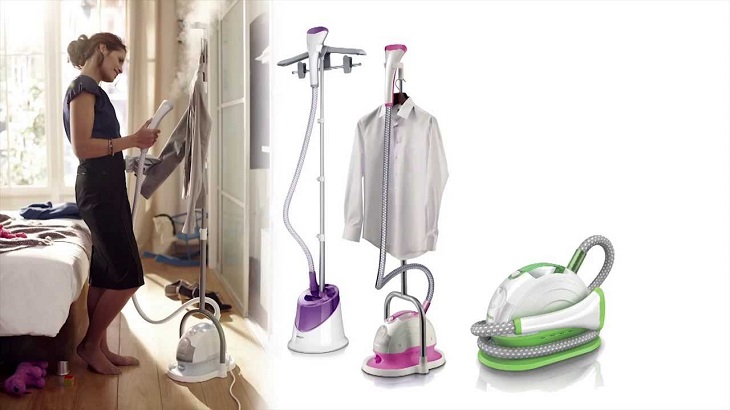
A clothes steamer is a convenience tool, not a magic laundry machine. It relaxes many wrinkles quickly, refreshes a garment between washes, and works well on hanging shirts, dresses, knits, curtains, and light upholstery. It does not create the sharp, flat crease of an iron, remove stains, repair damaged fibers, or make a care label irrelevant. The best steamer is the one that matches how often you use it and the amount of fabric you actually need to handle.
For most people, a handheld steamer is enough. It is easy to store, heats quickly, and solves the “my shirt was folded in a suitcase” problem. An upright steamer is better for a wardrobe-heavy household, regular curtain work, or someone who steams several garments at a time. A travel steamer is worth carrying only when it is compact enough to earn its space and compatible with the voltage where you are going.
We compared current manufacturer specifications for heat-up time, water capacity, steam output, runtime, attachments, portability, and safety design. We also considered the limits of steaming across different fabrics. Product availability and bundles change, so use the Amazon links to check the current model before buying.
Our picks at a glance
Best handheld clothes steamer for most homes: Conair Turbo ExtremeSteam GS59X
Check the Conair Turbo ExtremeSteam GS59X on Amazon
The Conair Turbo ExtremeSteam GS59X is the right handheld steamer for someone who wants to use it regularly at home, not only once before a wedding. Conair lists an 1,875-watt steam generator, five steam settings ranging from delicate to turbo, a 40-second heat-up, and up to 20 minutes of continuous steam time. It also includes a 3-in-1 attachment with a silicone band to hold fabric taut, a delicate-fabric spacer, and a bristle brush, plus a built-in creaser and a quilted aluminum plate that can help with a more pressed finish.
The larger runtime is its main practical advantage. Many small handhelds are perfectly fine for one shirt but need refilling halfway through a second garment. Twenty minutes gives you enough breathing room for a work outfit, a few hanging pieces, or a quick curtain pass. The five settings also make this more adaptable than a simple one-button travel steamer. Start on the lowest appropriate setting and test a hidden area before committing to an unfamiliar fabric.
It is still a 3.2-pound handheld appliance, not a travel wand. Buy it for an apartment, home closet, or laundry room where you can hang garments securely and store the unit upright. If your goal is a crisp dress-shirt collar, sharp trouser crease, or perfectly flat linen tablecloth, an iron and board will be more efficient. The Conair is at its best on soft wrinkles, drape, and fast refreshes.
Best compact travel clothes steamer: Rowenta Pure Pop
Check the Rowenta Pure Pop on Amazon
The Rowenta Pure Pop is the travel-minded pick for someone who wants a small, quick touch-up tool and accepts the limits of a compact water tank. Rowenta lists a 15-second heat-up, 1,150 watts of power, up to 20 grams per minute of continuous steam, a removable 2.4-ounce tank, four minutes of steam time per fill, and a 1.57-pound weight. It includes a dual-sided pad with a dewrinkling side and a lint- or hair-removal side.
Four minutes is enough for a light dress, a shirt front, a knit, or a quick jacket refresh. It is not enough for a family’s formal outfits. That short runtime is not a flaw; it is the price of the compact tank and travel-friendly size. The right way to use it is to fill the tank, steam one item with deliberate passes, unplug it, let it cool, empty it if the manual requires, and pack it only once it is dry.
Before treating any travel steamer as international luggage gear, check the voltage rating and the country’s electrical standard. A plug adapter changes the plug shape; it does not necessarily convert voltage. Do not use a 120-volt appliance on a 230-volt supply unless the appliance is specifically rated for it or you have an appropriate transformer. Our travel adapter guide explains the distinction in more detail.
Best foldable steamer for occasional touch-ups: Philips 3000 Series STH3000/20
Check the Philips 3000 Series handheld steamer on Amazon
The Philips 3000 Series STH3000/20 is the sensible compact choice for occasional home and travel use. Philips lists a foldable body, roughly 30-second heat-up, 1,000 watts of power, up to 20 grams per minute of continuous steam, a 120 ml detachable water tank, a two-meter cord, a metal steam plate, and a storage pouch. The tank is sized for roughly one outfit before a refill, which fits the product’s purpose: a quick de-wrinkle job, not a full laundry-day appliance.
A foldable body matters more than it sounds. A steamer stored in a cramped bathroom cabinet or packed in a carry-on needs to be easy to put away. The detachable tank is another small quality-of-life feature because you can refill and empty it without wrestling the whole appliance over a sink. The heated metal plate can be gently pressed against ironable fabrics according to Philips’ guidance, but you should still keep the device moving and follow the care label.
Choose this Philips if you value compact storage, a simple setup, and a moderate price more than a large tank or a long runtime. It is not the right tool for heavy curtains, bedding, structured jackets, or an entire household’s wardrobe. If those are weekly tasks, the upright Jiffy is the better format.
Best upright clothes steamer for frequent use: Jiffy J-2000
Check the Jiffy J-2000 on Amazon
The Jiffy J-2000 is the durable upright choice for a household that steams often or needs to work through several garments in one session. Jiffy lists a 2.8-liter (three-quarter-gallon) water caddy that can be refilled during the steam cycle, 1,300 watts on 120-volt versions, a 5.5-foot flexible hose, a seven-foot power cord, swivel casters, automatic shutoff through a fusible link, and a steam duration of about 90 minutes. It is built more like a standing appliance than a travel accessory.
The big water reservoir changes the workflow. Instead of refilling a handheld every few minutes, you can steam dresses, shirts, curtains, bedding, or a day’s worth of clothing continuously. The tall structure and wheeled base also make it easier to work upright with a garment on a solid hanger. That is valuable for delicate, drapey fabrics that you do not want to flatten under an iron.
It has real trade-offs: storage footprint, hose management, more water to empty, and a much higher upfront cost. Do not buy an upright steamer for a single carry-on shirt before a vacation. Buy it when steaming is a real recurring chore and you have somewhere to store it safely. For a normal compact apartment routine, a handheld is usually more rational.
When a clothes steamer is the right tool
Steam for soft wrinkles, drape, and quick refreshes
Steam excels at relaxing creases in garments that are already hanging: blouses, dresses, knitwear, light jackets, trousers, skirts, shirts, curtains, and certain upholstery. It is especially helpful after a garment has been packed, stored folded, or worn once without becoming truly dirty. The key benefit is convenience. You can work vertically without setting up an ironing board and avoid direct dry heat on many delicate materials.
A steamer is also useful when a garment has texture, gathers, pleats, beads, or a shape that would be awkward to press flat. Hold the fabric gently taut from a safe distance, work in slow downward passes, and allow the garment to dry and cool before putting it on. Steam is moisture and heat; the result improves when you let fibers settle rather than immediately compressing the item back into a closet.
Use an iron for sharp creases and flat results
Choose an iron when you need a crisp collar, a dress-shirt placket, a sharp trouser crease, a flat cuff, or perfectly pressed linen. An iron combines heat, pressure, and a flat soleplate; a steamer mainly relaxes fibers. Trying to force a handheld steamer to do iron work wastes time and increases the chance that you will oversteam one area.
If you want both tools, a simple household iron plus a compact steamer is often the best arrangement. Use the steamer for the things you wear frequently and the iron for formal or structured pieces. You do not need a large upright steamer unless the volume justifies it.
Do not use steam to clean stains or ignore care labels
Steam can refresh an item, but it does not remove oil, food, makeup, mud, or set-in stains. Heat can make some stains harder to remove. Treat stains according to the garment care instructions before steaming. If an item is labeled dry-clean only, contains delicate trim, leather, suede, waxed fabric, glued details, or a material you cannot confidently identify, consult the care label and consider professional cleaning rather than experimenting with a hot appliance.
Never steam clothing while it is being worn by you or another person. Never point the steam head at skin, hands, pets, or anyone nearby. Steam can burn quickly, even when the device looks harmless and compact.
How to choose a clothes steamer
Handheld versus upright
A handheld steamer is best for one to three garments, occasional use, limited storage, travel, and fast touch-ups. Look at heat-up time, tank size, weight, steam settings, cord length, and whether it can sit upright safely. Do not shop only by wattage. A powerful unit with a small tank may still be the wrong tool for your workload.
An upright steamer is best for frequent use, large wardrobes, curtains, bed linens, and households that want long continuous runtime. Look for a stable base, a long hose, a large accessible water reservoir, useful safety shutoff, and enough storage space. The standing format saves refill time, but it is an appliance you need to maintain and store.
Tank capacity is really runtime
Tank capacity determines how long you can steam before a refill, though steam setting and technique change the real result. The Rowenta Pure Pop’s 2.4-ounce tank is designed for about four minutes; that is efficient for one shirt but not for a pile of laundry. The Philips 120 ml tank is similarly best for an outfit at a time. The Conair’s larger configuration provides up to 20 minutes, and the Jiffy’s 2.8-liter caddy supports much longer sessions.
Buy for the number of items you intend to steam back-to-back. A small tank is a feature when portability matters and a frustration when it does not. Do not fill past the marked maximum line or try to refill a hot unit against the manufacturer’s instructions.
Attachments should solve a real fabric problem
A fabric brush can help steam reach heavier or textured fibers. A delicate spacer creates distance from the fabric and can be useful around fine materials and trim. A creaser can help form soft folds and pleats. These attachments are useful when you understand their role; they are not proof that the steamer is better at every garment.
Start with the bare steam head or the maker’s suggested attachment on an inconspicuous area. Keep the head moving, and do not hold a hot plate on one place for more than a few seconds. Conair’s manual specifically warns that prolonged stationary steaming can cause shrinkage, melting, or color shift in certain materials. Delicate fabric deserves a test, not confidence from a product claim.
How to steam a garment safely and effectively
Read the label and prepare the garment
Check the care label first. Hang the garment on a sturdy hanger with enough room around it, button or zip it enough to hold its shape, and empty the steamer’s tank before filling with the water type its manual recommends. Keep the cord dry and away from the sink, and put the unit on a stable heat-resistant surface while it warms.
For a shirt, work from the collar and shoulders down the front, then the sleeves, then the back. For a dress, begin at the top and make slow downward passes. Hold the bottom hem or a side seam gently taut with one hand, keeping your hand out of the steam path. Let the fabric cool and dry for a few minutes before wearing or packing it.
Use slow, controlled passes
Fast waving makes a lot of steam and does little work. Move the head steadily along the fabric, letting the steam penetrate and the fibers relax. For stubborn wrinkles, repeat a slow pass rather than holding the head motionless. Thicker cotton, wool, and bedding may need more time; delicate synthetics and silk-like fabrics need a lower setting, a spacer if provided, and more caution.
Steam both sides of a difficult wrinkle when the care label permits. Use a hanger or a door press pad, not your own body or a hand behind the fabric. The goal is gentle tension and even heat, not pressing the garment into submission.
Empty and dry the steamer after use
Turn the unit off, unplug it, let it cool completely, and empty remaining water if the manual tells you to do so. Leaving water in a tank can encourage mineral buildup or leaks during storage. Wipe the exterior, make sure the cord is dry, and store attachments together so the delicate spacer or brush does not disappear before the next use.
If your water is very hard, follow the manufacturer’s descaling guidance. Do not pour vinegar, fragrance, fabric softener, or cleaning products into a steamer unless the manual explicitly allows it. Those additions can damage the appliance, create residue, or make steam less predictable.
Common mistakes to avoid
- Buying a travel steamer for a household laundry routine. Tiny tanks are useful on trips and frustrating for multiple garments.
- Expecting a steamer to make iron-sharp creases. Use an iron for structured, flat results.
- Steaming a garment while wearing it. Steam burns are a real risk; always use a hanger or stable surface.
- Ignoring the care label. Some materials, trim, coatings, and dry-clean-only items need different care.
- Holding steam over one area too long. Keep the head moving to reduce the risk of shrinkage, melting, or color change.
- Leaving water in the tank indefinitely. Cool, empty, and store the unit according to its manual.
- Using a plug adapter as a voltage converter. Check the appliance rating before international travel.
How we chose
We compared current steamers by the work they are best suited to: powerful regular handheld use, compact travel touch-ups, occasional foldable storage, and frequent large-volume steaming. We considered heat-up time, tank capacity, continuous steam output, runtime, weight, attachments, water handling, cord or hose reach, and explicit safety features. We also treated the care label as part of the buying decision, because no steamer is appropriate for every fabric.
This is product research, not a claim that we tested every steamer on every textile. Model bundles, specifications, electrical ratings, and availability can change. Confirm the current product details and consult garment labels before steaming. SuperGrail links to Amazon for shopping and may earn a commission from qualifying purchases. That does not change how we assess the trade-offs.
Clothes-steamer FAQ
Can a steamer replace an iron?
For quick wrinkle release and delicate hanging garments, often yes. For sharp creases, collars, cuffs, flat linen, and structured tailoring, no. A steamer relaxes wrinkles; an iron adds pressure and a flat soleplate. Many households benefit from having both.
Can I steam silk or delicate fabric?
Only if the care label allows it. Test an inconspicuous area first, use the lowest appropriate setting, use a spacer if supplied, keep the head moving, and avoid soaking the fabric. When in doubt, use professional cleaning or follow the garment maker’s guidance.
Why is my steamer spitting water?
Common causes include overfilling, not allowing the unit to fully heat, holding it at an angle the manual does not permit, mineral buildup, or attempting to steam with a low temperature. Turn it off, let it cool, check the water level and instructions, and clean or descale only as the manufacturer directs.
Can I take a garment steamer on an international trip?
Yes if it fits your luggage and the electrical rating is compatible with your destination. A plug adapter alone does not change voltage. Check the steamer’s label and your destination’s power standard before packing it.
Does steaming clean clothes?
Steaming can refresh a garment and reduce some odors, but it does not remove stains, oils, dirt, or allergens in the way washing or professional cleaning can. Treat stains and laundry needs according to the care label rather than relying on steam as a substitute.
Our approach: We explain the trade-offs behind every recommendation. If you buy through an Amazon link, SuperGrail may earn a commission—our research remains independent.