The best water bottle is the one that fits the way you actually drink water. That sounds obvious, but a bottle built for a desk, a backpack, a car cup holder, and a trailhead cannot make the same compromises. A straw is fast and convenient but adds cleaning parts. A wide-mouth screw cap is simple and reliable but asks you to stop and open it. Insulation keeps water cold but adds weight. The useful choice starts with the job, not the logo.
For most people, we recommend the Owala FreeSip 24 oz. It is insulated, leakproof when locked, and gives you the choice to sip through a built-in straw or drink from a wider opening. If you need a bottle that can be packed beside electronics with more confidence, choose the YETI Rambler 26 oz Bottle with Chug Cap. For a low-cost, lightweight bottle that is easy to clean and works with many filters, the Nalgene 32 oz Wide Mouth still makes sense.
None of these is perfect for every day. This guide explains where each works, what “leakproof” really means, and how to avoid buying an expensive bottle that spends its life in a cabinet because the lid is annoying to use.
Our picks at a glance
- Best water bottle for most people: Owala FreeSip 24 oz. An insulated, push-button bottle with a leakproof locking lid, built-in straw, and a wider swig opening.
- Best bag-safe insulated bottle: YETI Rambler 26 oz Bottle with Chug Cap. A dishwasher-safe, double-wall insulated bottle with a 100% leakproof screw cap and wide-mouth body.
- Best lightweight bottle for everyday and outdoors: Nalgene 32 oz Wide Mouth. A light, leakproof, dishwasher-safe 32-ounce bottle with a wide opening that accepts many filters and ice cubes.
- Best if you want a covered straw: a YETI Rambler with a Flip Chug Cap is convenient for cold water, but lock the cap before carrying it and follow the manufacturer’s restrictions on hot or carbonated drinks.
Best water bottle for most people: Owala FreeSip 24 oz
The Owala FreeSip 24 oz is a good everyday bottle because it reduces the tiny annoyances that keep people from using bottles consistently. Its push-button lid opens to reveal a FreeSip spout: hold the bottle upright and drink through the built-in straw, or tilt it and use the wider opening. The lid locks when closed, the body is triple-layer insulated, and the wide opening makes adding ice and cleaning easier than a narrow-neck bottle.
The two drinking methods are not a gimmick. A straw is useful at a desk, in a car, or while walking because you do not need to tip the bottle. The wider opening is better for a bigger drink or when you do not want to pull water through a straw. The 24-ounce size is substantial without becoming a full workout to carry. Owala also makes larger sizes, but 32- and 40-ounce bottles become less pleasant in cup holders and more awkward when full.
Use the lock. A push-button lid is only bag-safe when it cannot open accidentally. Before putting it near a computer, close the cap, slide the lock, and give the bottle a gentle upside-down test over a sink. That simple habit matters more than any marketing phrase. Clean the straw and lid components regularly; a straw system has more surfaces than a screw cap, which is the price of easy sipping.
Choose the FreeSip if you want a bottle to live beside you all day—desk, car, gym bag, and short outing. Skip it if you need a completely simple threaded cap for a crowded travel pack, or a very light bottle for a hike where insulation is not worth the weight.
Best bag-safe insulated bottle: YETI Rambler 26 oz with Chug Cap
The YETI Rambler 26 oz Bottle with Chug Cap is the choice when a bottle needs to survive life inside a bag. It has a 26-ounce double-wall insulated body, a handle that twists off with the cap, a dishwasher-safe spout, and a wide mouth for filling and washing. YETI describes the Chug Cap as 100% leakproof.
This is a more deliberate hydration bottle than the Owala. You twist the cap to drink, so it is not quite as effortless at a desk. In return, the threaded closure is reassuring for a backpack, carry-on, or car floor. The controlled chug spout is a reasonable middle ground between an open wide-mouth bottle and a straw. It also keeps the bottle’s exterior design simple enough that you can see whether the cap is actually closed.
YETI’s own restrictions matter: do not use the Chug Cap with carbonated drinks, boiling contents, food, or perishable liquids, and do not use it for contents above 185°F/85°C. This is a cold-water bottle first. If you want hot coffee or tea, use a product designed for hot drinks; our travel mug guide separates bag-safe hot-drink lids from basic tumblers.
The downside is weight and cost. The insulation and sturdy construction are welcome in a crowded commute but unnecessary for a short walk with room-temperature water. Buy the YETI because the sealed, insulated workflow matters to you, not because every bottle needs to feel indestructible.
Best lightweight bottle for everyday and outdoors: Nalgene 32 oz Wide Mouth
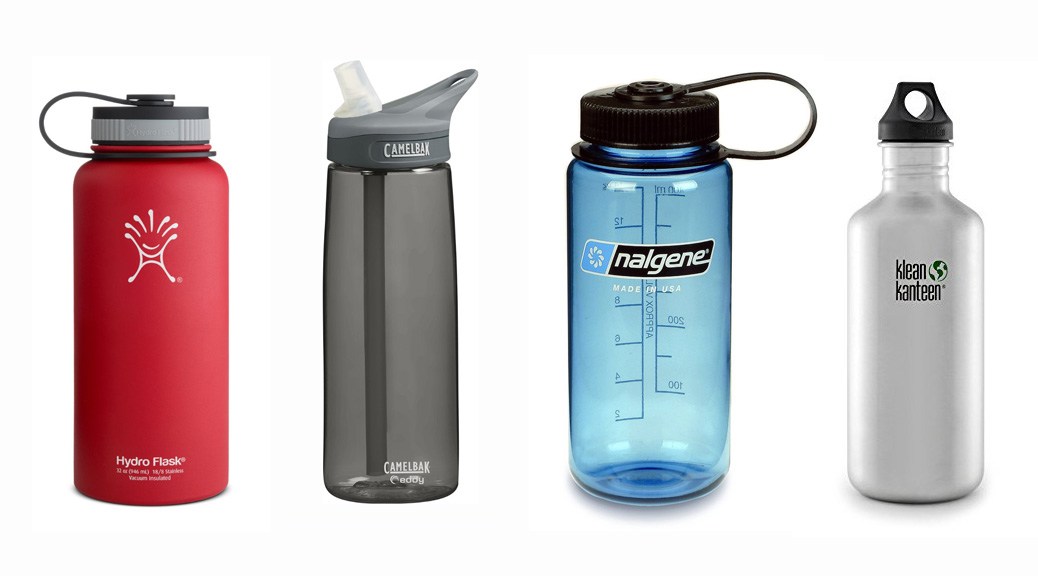
The Nalgene 32 oz Wide Mouth remains a strong choice because it is honest about what it is: a light, large, simple bottle. The current Wide Mouth uses Tritan Renew, is BPA/BPS-free, dishwasher safe, leakproof, and made in the United States. Its 32-ounce capacity, 3.5-inch diameter, and wide threaded opening make it easy to fill, clean, and use with many water-filter systems.
It is the practical option for hiking, camping, travel days, a big desk bottle, or anyone who prefers knowing exactly how much water they have finished. The clear or lightly coloured sides make water level visible. The wide mouth takes ice cubes without a fight, and a screw cap has fewer hidden channels than a straw lid. At about 6.25 ounces empty, it is dramatically lighter than an insulated steel bottle of similar capacity.
Its limitation is equally clear: no insulation. Water warms up in a hot car, and the broad mouth can make it less graceful to drink from while moving. Some people add an aftermarket splash guard or narrow-mouth insert; that can make drinking easier but also adds another piece to wash. Start with the bottle as sold and add an accessory only if it solves a real problem.
Choose Nalgene when capacity, weight, cleaning, and filter compatibility matter more than ice-cold water. It is not fancy. That is why it works.
Leakproof is a state, not a category
A bottle can be leakproof when fully closed and still be a bad choice for a bag when its lid is open, unlocked, or easily bumped. A straw cap might be perfect on a desk but come open in a backpack. A flip spout can be hygienic and quick but have more gasket surfaces. A threaded cap takes longer to use but is usually easy to inspect and secure.
Think about where the bottle will travel. For a laptop bag or a personal item on a flight, use a screw cap or a positive lock and keep the bottle upright. For a desk, gym, or cup holder, a straw cap is comfortable and encourages regular drinking. For a trail, a lightweight wide-mouth bottle may be best because it can accept a filter and does not add pounds before you even fill it.
Test every new bottle at home with cool water before trusting it on a trip. Fill it, close it exactly as instructed, invert it over a sink, and look for drips. This is a better test than a product claim and much cheaper than learning the answer after a water bottle meets a laptop charger.
Choose capacity around the places you can refill
More capacity is not always better. A 40-ounce bottle can be useful on a long drive or a hot day without refills, but it is heavy when full and too large for many bags. A 16- to 20-ounce bottle is easy to carry but requires more refills. Twenty-four to 32 ounces is the practical middle for most people.
- 16–20 ounces: good for a short commute, a child’s bag, or a situation with reliable refill stations.
- 24–26 ounces: the everyday sweet spot for a desk, car, or gym session.
- 32 ounces: useful for a trail, travel day, or anyone who would rather refill less often.
- 40 ounces and above: useful only when you have a practical place to carry the weight and bulk.
Do not buy a giant bottle as a substitute for a drinking habit. A smaller bottle you refill and clean is more useful than a huge one you avoid carrying.
Steel, plastic, glass, and the honest trade-offs
Stainless steel insulation keeps drinks cold and does not need to be babied, but it weighs more and can hide the water level. Plastic bottles such as Nalgene are light, inexpensive, and easy to see through, but they do not keep water cold. Glass does not retain flavours and feels pleasant to drink from, but it needs a protective sleeve and is a poor fit for rough travel. There is no best material in the abstract.
Choose insulated steel for a commute, a hot office, or anyone who drinks more when water stays cold. Choose plastic for hiking, filter use, large capacity, or simple cleaning. Choose glass for a protected desk setting where taste and visibility matter more than durability. The right material follows the context.
Cleaning is part of the purchase
Every bottle should be cleaned regularly, but the lid determines how irritating that becomes. A wide-mouth bottle with a screw cap is quick to scrub. A straw lid needs the straw, mouthpiece, gasket, and small channels cleaned separately. An insulated bottle may be dishwasher safe, but verify the instructions for the exact cap and finish before relying on a high-heat cycle.
Rinse daily, wash the lid carefully, and leave the bottle open to dry. Do not wait for a smell to tell you it is time. If you use sweetened drinks, electrolyte mixes, or anything other than water, clean it sooner. Replace a worn gasket or cracked straw instead of assuming the whole bottle is finished. Most leaks and odours begin in small, inexpensive parts.
Water bottles on flights and travel days
An empty reusable bottle is easy to carry through security; fill it after you pass the checkpoint. Keep the cap closed during takeoff and landing, when pressure changes and an overfilled bottle can behave unpredictably. A bottle with a reliable closure also belongs away from power banks and charging gear in a bag. See our travel power checklist for a simple way to keep that pouch separate from food and liquids.
For destinations with uncertain water access, select a bottle with a capacity and opening that suit the filtration method you plan to use. Nalgene’s Wide Mouth works with many filters, but confirm the specific filter compatibility before you leave. A bottle alone does not make unfamiliar water safe.
Cup holders, backpacks, and the details that change daily use
Measure the places where the bottle spends its day. A bottle can be excellent and still be wrong for your car’s cup holder, the side pocket on your commuter backpack, or the narrow sleeve on a treadmill. Diameter matters more than capacity here. The Nalgene is wide at 3.5 inches; the Owala and YETI are slimmer but taller when their lids and handles are included. Use the published dimensions as a starting point, then compare them with the actual opening you use.
Backpack pockets have their own demands. A tall bottle that protrudes above a shallow side pocket is easy to grab but more likely to fall out when you bend down. A heavy insulated bottle can pull a loose mesh pocket outward. In a travel bag, a sealed bottle is usually safer in an exterior pocket than inside the main compartment, even when the lid is theoretically leakproof. That placement also keeps condensation and accidental drips away from documents and electronics.
Handles and loops are useful when they make the bottle easier to carry, not when they add a snag point. Check that a loop lies flat enough for a bag and that a carabiner attachment will not swing against the bottle or catch on a seatbelt. These details are unglamorous, but they decide whether a bottle accompanies you or stays on the kitchen counter.
If cup-holder fit is non-negotiable, measure it before ordering. “Fits most cup holders” is helpful guidance, not a universal measurement standard shared by every vehicle.
What we would avoid
- An open tumbler for a bag. It may be pleasant at a desk but is not a substitute for a locking bottle.
- A giant bottle without a carrying plan. Full water is heavy; capacity is useful only when you will take it with you.
- A straw lid you never clean. Convenience becomes a downside when small parts collect residue.
- Using a cold-water cap for hot or carbonated drinks. Follow the manufacturer’s restrictions rather than treating every bottle as interchangeable.
- Assuming a wide mouth makes water safe. Filter compatibility and water treatment are separate questions.
How we chose
We looked at the basic problems a water bottle must solve: closure security, drinking comfort, insulation, capacity, weight, cleaning access, and whether it fits a real carry situation. The Owala FreeSip wins for everyday convenience. The YETI Rambler is the bag-safe insulated option. The Nalgene 32-ounce Wide Mouth is the lightweight, simple bottle for outdoors and large-volume use.
We revisit this guide when materials, caps, product restrictions, or availability change. Use the Amazon links as current availability checks instead of treating prices as permanent.
Water bottle questions, answered
What size water bottle is best for daily use?
Twenty-four to 26 ounces is the versatile middle ground for most people. It holds enough water for a meaningful stretch between refills without becoming too heavy or awkward in a bag.
Are straw bottles leakproof?
Some are leakproof when fully closed or locked, but that is not the same as being safe when the cap can open in a bag. Check the specific lid, close it carefully, and test it at home before travelling.
Is stainless steel or plastic better?
Stainless steel is better for cold retention. Plastic is lighter, easier to see through, and often better for hiking or filter use. Choose based on where and how you will use it.
How often should I wash a water bottle?
Rinse it daily and clean the bottle and lid regularly, especially after anything other than plain water. Straw assemblies and gaskets deserve extra attention.
Can I bring an empty water bottle through airport security?
Generally, yes—carry it empty through security and fill it afterward. Check the rules for the airport and country you are travelling through, especially for unusual bottle accessories or filters.