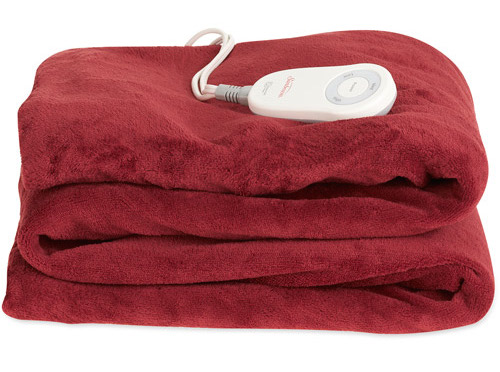
An electric blanket can make a cold bed comfortable without turning up the whole house. It is also an electrical heating appliance woven into bedding. That makes the most important buying questions reassuringly practical: Is it from a reputable seller? Does it have clear instructions and a recognized safety listing? Can you keep it flat, inspect it, plug it directly into a wall outlet, and use it without trapping heat or crushing the cord?
Our preferred use case is pre-warming a bed while you are awake, then turning the blanket off before sleeping unless the exact manufacturer instructions and your healthcare needs clearly support another approach. Automatic shutoff is useful backup, not permission to ignore condition, placement, or heat sensitivity. If someone in the household cannot reliably feel heat, operate the controller, or respond if something is wrong, a non-electric blanket is often the better choice.
Our picks at a glance
- Best mainstream pre-warm option: Sunbeam Royal Ultra heated blanket is the kind of widely available model to compare for clear controls and a documented automatic shutoff.
- Best plush-fabric option: Biddeford Microplush heated blanket is worth considering when the exact size, controller, care directions, and safety listing fit your household.
- Best dual-zone direction: a Beautyrest dual-control heated blanket can be useful for two sleepers who need independent settings, provided both sides can be operated and inspected safely.
- Best non-electric alternative: a warm fleece or wool blanket, layers, and a warmer bedroom setup for anyone at elevated heat or electrical risk.
- Best safety upgrade: a new, clearly identified blanket from a reputable retailer—not a used or mystery-brand electrical blanket.
Buy the safety information before the softness
Do not choose a heated blanket from a photo and a star rating alone. Read the product listing for the exact model number, stated size, controller type, care instructions, safety listing, warranty, and return process. Look for evidence that the electrical product is listed by a nationally recognized testing laboratory, such as UL, ETL, or CSA, for the market where you will use it. A listing badge is not the same as the mark on the product and its packaging, so inspect the item on arrival.
Buy new from a reputable seller. Used electric blankets, thrift-store finds, garage-sale bargains, and unsealed marketplace listings have unknown storage, damage, repair, recall, and controller history. You cannot tell from a soft surface whether internal wires have been crushed or whether a past owner used an incompatible controller. A modest saving does not justify uncertainty with a heat-producing electrical appliance.
Open the box before the return window ends. Confirm that the controller, connector, cord, instructions, and sizing match the listing. Read the manual before connecting power. If anything is missing, damaged, confusing, or inconsistent with the advertised model, return it. Do not improvise with an older controller, spare cord, adapter, or third-party attachment. Heated bedding is designed and tested as a system.
Choose the right kind of heated bedding
“Electric blanket,” “heated throw,” and “heated mattress pad” are not interchangeable terms. A blanket lies over the body; a heated mattress pad lies on the mattress; a throw is usually designed for seated use. They have different placement, cord, cleaning, and use instructions. Do not use a blanket like a pad, put a heated throw under fitted bedding, or stack two heating products just because each has a low setting.
For a bed, confirm the blanket is actually sized for the mattress and whether it is meant for a single sleeper or has two zones. An oversized blanket that must be tucked, folded, or bunched is a safety problem, not a cozy upgrade. A dual-control model is useful only if each person can reach and understand their control and the wiring remains flat and accessible.
For a couch or reading chair, a heated throw may make more sense than dragging a bed blanket into a different setting. It still needs an outlet, clear cord path, and direct supervision. Do not use any heated bedding outdoors, in a damp location, or where it could be covered by pets, cushions, luggage, or other insulating objects.
Our product guidance
Sunbeam Royal Ultra for conventional bed pre-warming
Sunbeam Royal Ultra heated blanket represents the mainstream model category to consider when you want simple pre-warming, multiple heat settings, and an automatic-shutoff feature. The automatic shutoff is welcome, but it is not the primary reason to choose it. You should still follow the manual, keep the blanket flat, avoid sleeping on a bunched area, and turn it off before bed when the product guidance and your circumstances call for that.
Check the current product listing carefully. Heated bedding names can span different materials, sizes, wiring layouts, and controller designs. Choose the simplest controller you can read in low light and operate without guesswork. You do not need an app, remote control, or a long menu to warm a bed safely. A physical controller with clear labels can be the more usable option.
Biddeford Microplush for a softer surface
Biddeford Microplush heated blanket is a fabric-forward option to compare if you prefer a plush feel. The surface material is a comfort feature; it does not lower the need for careful electrical use. Before buying, check whether the exact model is machine washable, how the controller disconnects, whether washing requires a specific cycle or drying method, and whether it is suitable for your bed dimensions.
Never wash, dry, fold, or store a blanket in a way that conflicts with the manual. Remove controllers only as directed. Do not assume every electric blanket can be laundered the same way, and do not plug a blanket back in until it is completely dry and reassembled correctly. If washing instructions are missing, contact the manufacturer or choose another product rather than guessing.
Dual-control blankets for two sleepers
Beautyrest dual-control heated blankets are the kind of option that can make sense for a shared bed with different comfort preferences. The trade-off is more hardware: two controllers, more cord routing, and a need for both people to understand the settings and safety rules. Check that each side works as documented during the return period and that cords can reach outlets without running under the mattress, through a bed frame, or across a walking path.
Do not solve a cold side of the bed by adding another heating pad or electric throw on top of the blanket. Layers can trap heat and create an unsafe setup. If one person needs more warmth than the other, use independent settings within the blanket’s instructions or choose non-electric layers for the colder sleeper.
Set up the bed correctly
| Do | Why | Do not |
|---|---|---|
| Plug directly into a wall outlet | Reduces overload and cord issues | Use an extension cord, power strip, or adapter |
| Keep the blanket flat and untucked while operating | Avoids concentrated heat | Fold, bunch, tuck tightly, or pin it down |
| Keep controls and connectors accessible | Lets you inspect and turn it off quickly | Trap cords under the mattress, bed frame, rug, or furniture |
| Use it without extra objects on top | Helps prevent trapped heat | Cover it with heavy bedding, cushions, pets, or another heating product |
| Inspect before each season and regularly during use | Finds damage before use | Keep using it because the blanket still feels warm |
Read the manual for the intended layering order. Some blankets are meant to sit above a top sheet, while other heated products have different placement. The exact setup matters. Do not assume that wrapping the blanket tightly around the body, inserting it between mattress layers, or putting it under a duvet is safe simply because it feels warmer. Heat needs the conditions the manufacturer designed for.
Position the controller so it is not under pillows, blankets, or the mattress. The cord should have a clear path to the outlet without tension. Never staple, pin, tape, or crush the cord against a wall or bed frame. If the nearest outlet does not allow a safe path, choose a different room arrangement or a non-electric warming option.
Who should be especially careful
Heated blankets are not a casual choice for infants, young children, people who cannot safely operate the controls, people with reduced ability to sense heat, people who are paralyzed or have certain circulation or neuropathy concerns, people with urinary incontinence, and anyone who might be unable to respond to overheating. Ask a clinician about your individual situation rather than treating a low setting or automatic shutoff as a medical clearance.
Age alone is not the entire issue. The key question is whether the user can perceive heat, follow the instructions, adjust or switch off the blanket, and communicate if they feel unwell. In a caregiving situation, do not make an electric blanket a default comfort tool. Use safer layers, adjust the room temperature, or get clinician guidance if persistent cold intolerance is a concern.
Inspect, clean, and store it
Before every heating season and whenever something seems off, inspect the whole blanket. Look for dark, charred, frayed, cracked, or stiff spots; exposed or damaged wiring; loose connectors; unusual odor; uneven heating; controller malfunction; and plugs or cords that feel damaged. If you find any of these signs, stop using the product. Do not sew through it, tape a wire, bend a connector back into place, or try an online repair trick. Contact the manufacturer for approved support or replace it.
Wash and dry only according to the exact manual. Before cleaning, disconnect electrical components as specified. Do not dry-clean, bleach, iron, wring, or machine-dry a blanket unless the maker explicitly permits that method. Reconnect only when completely dry. A blanket that has been soaked, damaged by a spill, or exposed to water in a way the manual does not address should stay unplugged until the manufacturer gives clear direction.
For off-season storage, clean and dry the blanket first, then store it loosely according to its instructions. Avoid sharp creases, compression under heavy objects, and a damp garage or attic. Rolling gently may be preferable to folding for many models, but follow your specific manual. Keep the controller, instructions, and proof of purchase together so recall and care checks are easy next winter.
Make recall checking a winter habit
At the start of each cold season, find the product name and model number, inspect the blanket, and check the CPSC recall database and the manufacturer’s recall page. Register a new blanket with the manufacturer if registration is available. That gives the company a way to send recall notices directly. Do not assume a blanket is safe because it remains listed online or because it worked last winter.
If a product is recalled, follow the official remedy instructions. Stop using it if the recall says to stop, and do not give it away, sell it, or move it to a guest room. Keep the model information and receipt if possible. The safety remedy may involve a refund, replacement, or specific disposal instructions.
Common mistakes to skip
- Using a heated blanket while folded, bunched, tucked in, or under heavy layers.
- Plugging it into a power strip, extension cord, or overloaded outlet.
- Putting a pet, heating pad, or another electric blanket on top while it is on.
- Sleeping on a visibly damaged or unevenly heating blanket.
- Using a secondhand or unknown-brand blanket with no clear manual or history.
- Trying to repair a cord, connector, controller, or internal wire at home.
- Using it for someone who cannot safely sense heat or operate the controls.
Frequently asked questions
Is it safe to sleep with an electric blanket on?
Follow the exact manufacturer instructions and consider individual health needs. A conservative approach is to pre-warm the bed while awake, then switch the blanket off before sleep. Automatic shutoff is a backup feature, not a substitute for safe placement, a sound blanket, and the ability to respond to heat.
Can I put another blanket over an electric blanket?
Do not assume it is safe. Extra bedding, pets, or objects on top can trap heat. Follow the layering instructions for the exact model. If you need more warmth than the product setup provides, choose non-electric layers or adjust the room rather than stacking heating products.
When should I replace an electric blanket?
Replace it if it is damaged, heats unevenly, smells unusual, has a faulty connector or controller, has been recalled, or no longer has clear instructions. Age and condition both matter. A blanket that “still works” is not automatically safe.
Spend for fit and support, not extreme heat
An entry-level blanket may be enough when it has clear directions, a recognized safety listing, the correct size, and a controller you can operate easily. Spend more only when the added feature solves a genuine use problem: two people need separate zones, the fabric needs to be washable in a specific way, or the warranty and support make ownership more straightforward. There is no value in paying for dozens of heat settings that you will never use or a smart feature that makes the controller harder to understand at bedtime.
Use the return period as a safety evaluation. With the blanket laid flat on the actual bed, check that it covers the intended area without folding or tucking, that each connector sits as directed, and that both the controller and cord reach a wall outlet without strain. Inspect the initial warm-up while awake and nearby. If anything seems irregular—hot spots, a smell, a warm controller, an unexplained power interruption, or a cord that cannot be routed safely—unplug it and return it rather than trying to “break it in.”
For someone who is simply chilly at night, a better duvet, flannel or fleece layer, warm socks, draft reduction, and a programmable thermostat may provide more dependable comfort with less appliance risk. Electric warmth is a choice, not a requirement. The best blanket is the one that fits the household’s safety margin as well as the bed.
A two-minute pre-use checklist
Before turning on a blanket, look at the cord and controller, make sure the bed is dry, straighten any fold, remove objects and pets from the top, confirm that the controller is accessible, and plug directly into the wall. Turn it on only while you are present and able to check it. This small routine is more valuable than any marketing term on the package.
When the room has warmed and the bed feels comfortable, switch the blanket off and unplug it if the manual directs. This makes the transition to sleep a deliberate safety step instead of an assumption that the controller will manage everything for you.
The bottom line
Choose an electric blanket for dependable instructions, safe setup, and inspectability—not for the highest heat setting. A Sunbeam, Biddeford, or Beautyrest model can be a reasonable option when the exact product is new, listed, fits the bed, and can be used flat with a direct wall connection. Pre-warm conservatively, inspect it often, and skip electric bedding entirely when heat sensitivity or safe operation is uncertain.
For non-electric sleep comfort, see our bed sheets guide and wool socks guide.
Our approach: We explain the trade-offs behind every recommendation. If you buy through an Amazon link, SuperGrail may earn a commission—our research remains independent.